I go usually 4 to 5 mornings a week, weight training, core work, and cardio. I figure if I give up now I’ll just seize up so as I move further into my 50’s I see so many more benefits than just working on the physique and I’m amazed how many of the same faces I see each visit.

Each time, I see a group of people who also go to the gym regularly at that time. All of you have a shared interest and follow similar attendance patterns.
They fall into three categories, those you bond with and chat with in the changing room or at the water cooler, and some of those can become gym buddies or even friends. The second category is those you share eye contact with and pass a mutual nod of greeting or a polite smile. Thirdly there is the third category with whom there is no interaction, even eye contact does not elicit any acknowledgment from either party.
The level of mutual acknowledgment is immaterial though, we develop an unspoken, unacknowledged bond (in the case of categories two and three), and we see them as often as our workmates and more often than many of our family. We notice when a regular isn’t there for a week or so and we wonder about how they are. This unspoken bond is demonstrated most strongly if we see a fellow gym user outside the gym, even the ones we don’t acknowledge in the gym itself will give you a fleeting moment of eye contact, a tiny almost indistinct moment of recognition of that bond and common interest.
A similar occurrence happens at work with our colleagues, except we often see them much more than our family and friends. As with the gym, we have colleagues with whom we bond on a personal level. Others, maybe the majority, we acknowledge as straightforward colleagues. Then there’s some we see but don’t work alongside or have interactions with and so we maybe smile at or nod our head to acknowledge.
Our colleagues have a fundamental impact on our workplace attitudes and behaviors. I read that 70% of skills are picked up by employees through their jobs, 20% through peers and colleagues, and 10% through formal training sessions (Docebo, 2020).
It is that 20% that teaches us ‘shop floor politics and how things are done’ and managers ignore this at their peril. The reason? The fundamental presence of ‘The Psychological Contract’.
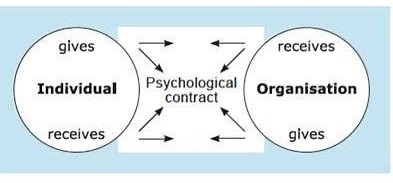
The CIPD describes the psychological contract as referring to an “individual’s expectations, beliefs, ambitions, and obligations, as perceived by the employer and the worker’.
It is an unwritten, often unspoken, contract between employer and employee. The expectations of an employee are formed by promises made by an employer, explicit or implicit. For example, Tommy comes for the interview, and the interviewer is very impressed and assures Tommy that within 6 months he would be promoted to supervisor. Six, seven, and twelve months pass and the promotion isn’t mentioned again and doesn’t happen. The psychological contract is broken.
So what happens? As the employer you have risked turning Tommy into a toxic employee. As a result that 20% of peer learning a new hire may get from Tommy could be about how the company lets you down, and generally negative messages about what the new hire can really expect from their new employer. It’s not Tommy’s fault but the damage is being done.
So if you take over a department or team and you realise or are warned about potential ‘trouble makers’, don’t take this at face value. Dig a bit deeper with them and find out if something happened on their journey because you can rebuild that unspoken contract. When you do, the positive messages it, and they, will send out could ensure that part of your positive training is helped, not hampered by the colleagues your new hires work with.





 Mannix HR